Rail vs road transport of biomass — when rail pays off
Rail pays off from 1,000 t per delivery. Below that — road wins. Concrete cost bands, break-even points, and when rail is unavailable even for large volumes.
When rail is on the table
Three conditions must be met at once:
- Rail siding at the customer's plant (or at a buffer warehouse within 30 km from which road can reach the plant). Without a siding rail makes no sense — reloading wagon-to-road erases the benefit.
- Volume per delivery ≥ 1,000 t — smaller mass does not fill an optimal train set (typical: 20 wagons × 50 t = 1,000 t or 25 wagons × 60 t = 1,500 t). An 8-wagon train exists but unit cost jumps by 20%.
- Delivery frequency ≤ once a month — rail is a logistics event. Trains are planned a week in advance, unloading takes 8–12 hours. You do not do this four times a month.
Unit cost in practice
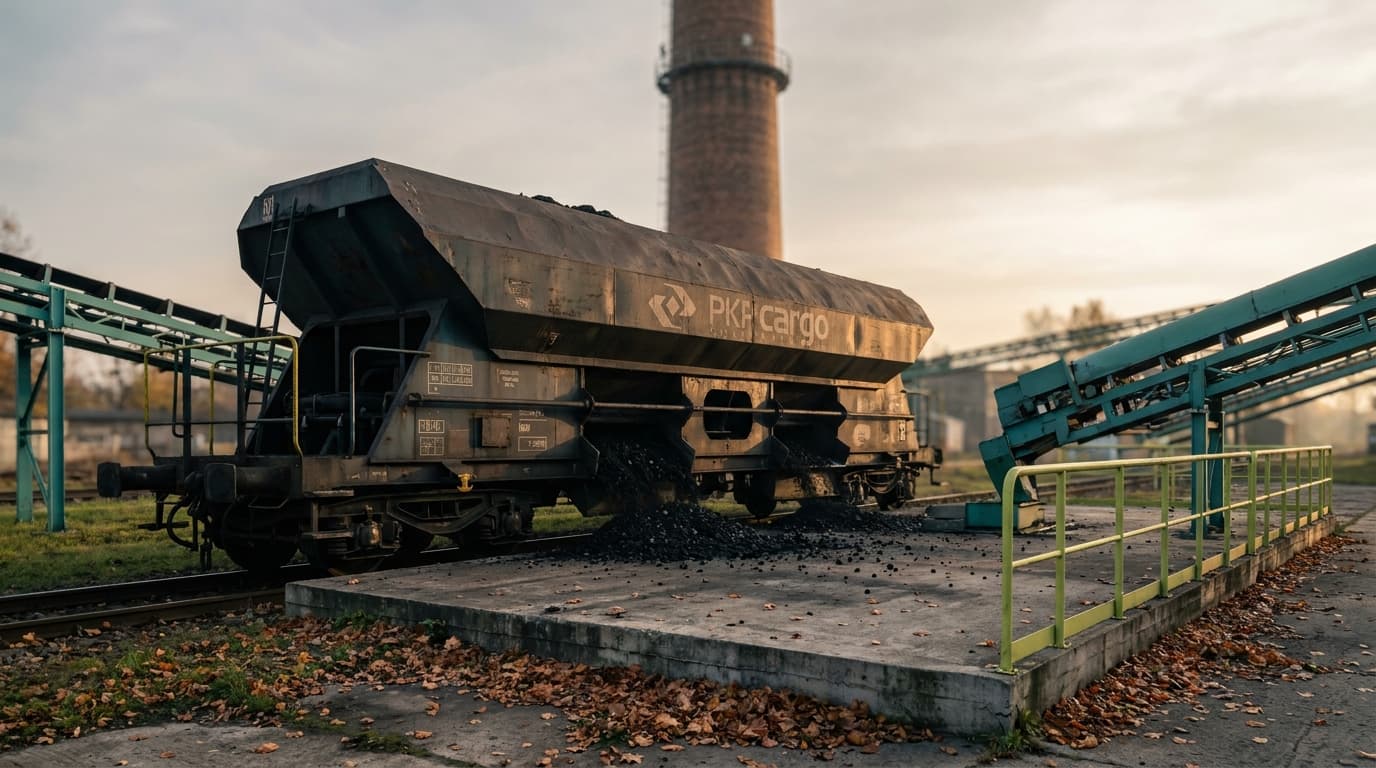
A2 bulk pellet by self-discharge wagon on 300 km (typical from the Baltic states or Western Poland):
- Rail cost = 65–85 PLN/t
- Siding reload cost (infrastructure fee, labour) = 5–8 PLN/t
- Total: 70–93 PLN/t
A2 bulk pellet by pneumatic tanker at the same 300 km:
- Tanker cost = 110–130 PLN/t (25–27 t/trailer, 300 km)
- Total: 110–130 PLN/t
Rail advantage: 35–40 PLN/t at 300 km. For 1,500 t volume = 52,000–60,000 PLN saving on a single delivery.
But rail's fixed costs are higher: infrastructure management fees, siding access fees (if the customer does not own it), planning and dispatch overhead.
Break-even at 200 km: ~800 t/delivery. At 400 km: ~600 t/delivery. At 100 km: rail practically never pays.
Rail for PKS and imports
Rail is the default for PKS and imported Baltic pellet. Reason: PKS lands in a container in Gdynia or Gdańsk; Baltic pellet lands similarly in Gdańsk. Distance to a plant in central Poland: 200–400 km — ideal for rail.
Typical PKS scenario: 20,000 t/year on framework, deliveries in three-month cycles of 5,000 t (100 wagons in 5 sets) to the plant siding. Logistics cost from terminal to customer: ~90 PLN/t. Same volume by road ~135 PLN/t — 900,000 PLN annual saving.
Road wins for smaller volumes
Below 500 t per delivery road is cheaper operationally and faster. Order 5 days ahead, delivery within 24 h of loading, unloading in 2–3 h. Schedule flexibility (shift by a day via email) is impossible for rail.
Delivery to a plant without a siding, or with a siding in poor condition (irregular wagon service, no shunting locomotive) → road only.
Winter with rail-paralysis risk (snow, frost, wagon heating failure) → road handles conditions better. In critical season moments (January–February) booking road is safer.
Three GFT transport patterns in practice
Customer A: CHP plant with a siding, 20,000 t PKS/year
- Rail: PKS from Gdynia terminal, 4 deliveries × 5,000 t/year, logistics cost ~90 PLN/t
- Road: top-up A2 pellet (2 × 500 t in critical moments), cost ~120 PLN/t
- Blended cost: ~92 PLN/t average
Customer B: 8 MW municipal plant without a siding, 6,000 t A2 pellet + chips/year
- Rail: not viable (no siding). Rail + reload at Kutno hub + road = more expensive than road alone.
- Road: pneumatic tankers for A2 pellet bulk, walking floor for chips, 1,000 kg big bags for emergency A1. Logistics ~110 PLN/t average.
Customer C: CHP without own siding but with own buffer warehouse within 20 km of Kutno hub
- Rail to buffer (Kutno) + road from buffer to plant (20 km). Rail cost ~80 PLN/t + reload and 20 km road ~15 PLN/t. Total ~95 PLN/t.
- Alternative: road from Gdynia terminal to plant (350 km) = 125 PLN/t.
- Saving 30 PLN/t for large volumes.
Traps that cost money
1. Siding booking in the last week
Infrastructure manager PKP PLK schedules week ahead. "For tomorrow" bookings incur schedule-change fees (2,000–5,000 PLN/train) or a missed slot.
2. Wrong unloading sequence
A self-discharge wagon empties by gravity in 15 minutes. But a 20-wagon set needs 20 × 15 = 5 hours plus shunting. Without a well-organised unloading area, wagons wait — parking cost 1,500 PLN/wagon/day.
3. Moisture in the wagon
Self-discharge wagons have no roof (or a variable roof). Rain during 3 days of transport = +3–5 pp fuel moisture. Result: lower calorific value, longer drying in the boiler. Fix: reusable wagon covers by the supplier (+~3 PLN/t) or transport only in dry periods.
GFT practice
For a customer weighing transport options we prepare a CIF customer warehouse comparison (fuel + transport + unloading) for every available option. The customer receives a 6-season projection.
We work with 3 rail forwarding firms (biomass-specialised) and a network of 15 road hauliers (chips and pellet specialists). For volumes above 3,000 t/month we run a tender across 3 rail providers and pick the season's best rate.
FAQ
How many wagons for 1,000 t pellet? A 60 t self-discharge wagon carries 55–58 t net. For 1,000 t = 18–19 wagons. Minimum operational train is usually 20 wagons (1,100–1,150 t).
Can wagons be delivered singly? Yes, but unit cost jumps 25–35%. Single-wagon works only above 500 km or for customers with a siding on a regular timetable (low order frequency).
Does the supplier insure the shipment on rail? Yes, standard — CARGO transport insurance covers full cargo value plus reload costs. If damage occurs in transit, the customer does not pay for the lost batch.
What if the siding is under maintenance? Contract force-majeure clause: if the customer's siding is unavailable > 7 days, we convert to road from the buffer warehouse (added 15–25 PLN/t, split 50/50 with the customer).
Summary
Rail pays off from 1,000 t per delivery, for customers with a siding, on 200–500 km distances. Below that road wins. It is simple economics with concrete numbers.
Green Fuel Trading has no "default" transport — for every customer we run CIF on 3 options (rail, road, mix) and recommend the most economical. Send us your plant's parameters (siding yes/no, annual volume, seasonality) — we deliver a comparison in 3 business days.