Sunflower husk pellet in fluidised-bed boilers — parameters and wood blends
Calorific value 16–19 MJ/kg beats wood pellet, but chloride and alkali risks come with it. When it pays off, how to blend with wood, and what share Polish BFBs tolerate.
Where it comes from and why it appeals
Sunflower husk is a residue of sunflower-oil pressing. Bulgaria, Romania and Ukraine — Europe's main sunflower-oil producers — generate large husk volumes as a by-product. Pelletised (usually 6–8 mm), delivered in bulk or 1,000 kg big bags, used in heating as an agri fuel.
Technical parameters:
- Calorific value: 16–19 MJ/kg (above A2 wood ~17 MJ/kg, comparable to A1)
- Ash: 2.5–4% (much higher than wood — 0.7–1.2%)
- Moisture: ≤ 10%
- Mechanical durability: 96–98%
- Wholesale price (October 2026, CIF Poland): 710–840 PLN/t
Price 15–20% below A2 pellet at comparable calorific value = lower PLN/GJ. That's what makes it economically attractive.
Three boiler-side risks
1. Chloride risk (Cl > 0.1%)
Sunflower husk carries chlorine 0.08–0.15% (wood: 0.01–0.04%). Three to ten times more. At high temperature chlorine reacts with ash to form metal chlorides that accelerate heat-exchanger tube corrosion.
Critical exchanger wall temperature: 400 °C. Below — chlorides are less aggressive. Above — corrosion can run 5–10× faster than on clean wood.
BFB boilers running below 400 °C: sunflower burns without issue. CFB boilers running above 500 °C: limit sunflower to 15% blend or skip entirely.
2. Alkali risk (K + Na > 1%)
Sunflower ash is rich in potassium and sodium. K + Na together ~1.5–2.5%. Alkalis lower ash softening temperature — ash sintering on grates or in cyclones can block boiler operation.
Boilers with low bed temperature (700–850 °C typical BFB for biomass): sunflower OK up to 25%. High-temperature boilers (900+ °C typical for coal): not viable.
3. Quartz-silica dust (SiO2)
Sunflower husk carries field quartz dust (not always — depends on country and pressing tech). Quartz + alkali → quartz-silicate slag on grates. A local but dangerous effect.
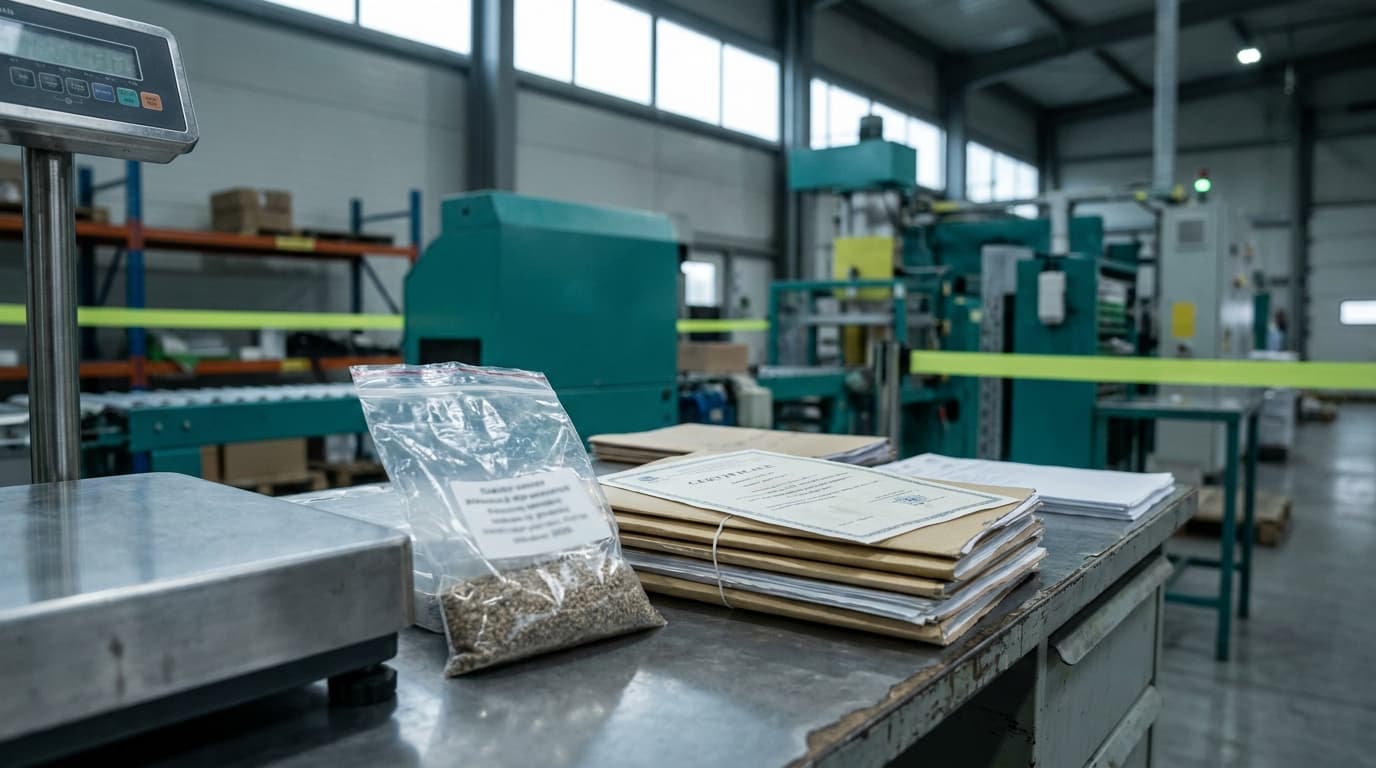
Practice: we buy sunflower pellet with a "low silica" certificate (SiO2 in ash < 15%) — Bulgarian and Romanian suppliers offer this. Ukrainian pellet is sometimes higher.
Blending with wood — the 15–25% rule of thumb
Practical recommendation for Polish BFB/CFB boilers:
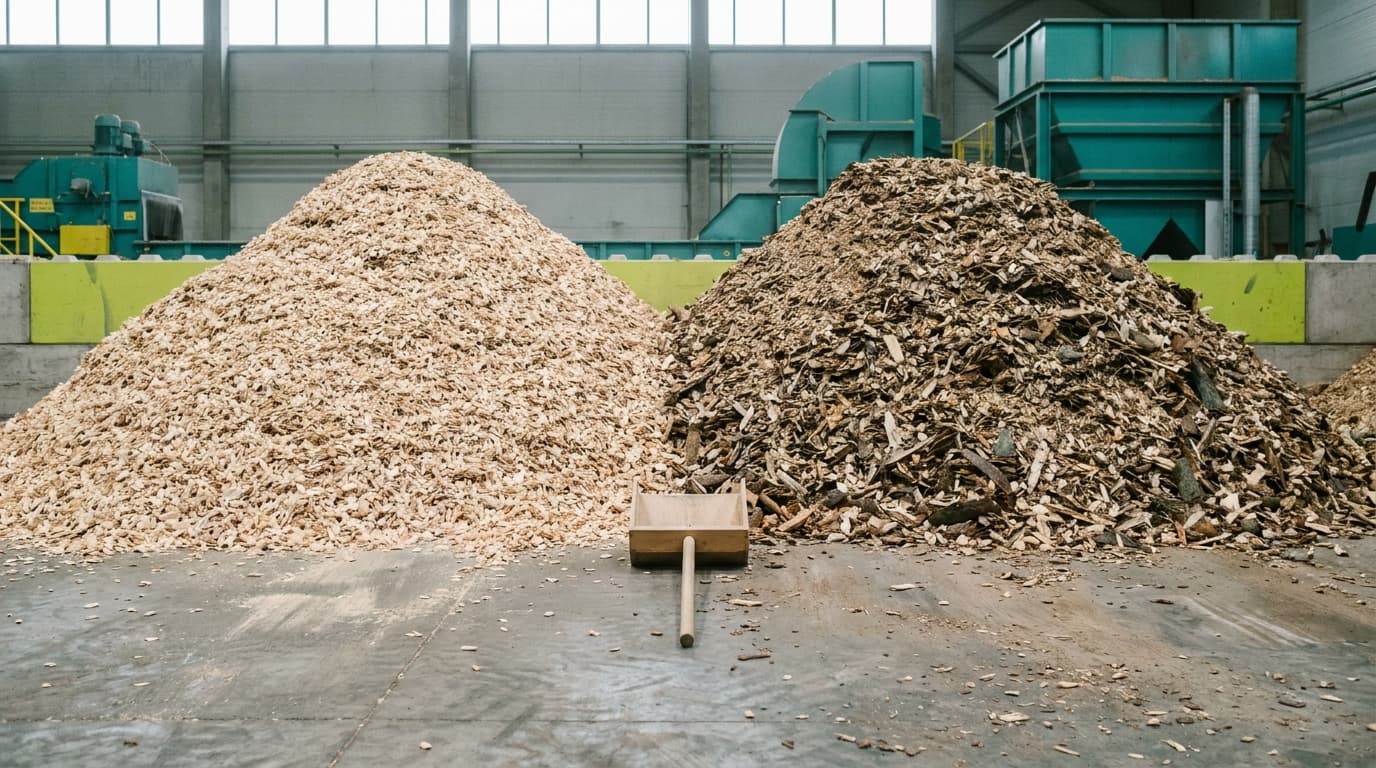
- 15% sunflower + 85% wood — safe for practically all BFBs. Chloride and alkali risks stay in bounds.
- 25% sunflower + 75% wood — maximum-economy window for BFBs running bed temperature below 850 °C. Big price saving at manageable risk.
- Above 25% — only for boilers specifically designed for agri biomass (rare in Poland).
A 20% blend is a common compromise.
Economics of a 20% blend
A 20 MW CHP plant burns 25,000 t of A2 pellet/year. A2 price: 950 PLN/t. Annual fuel cost: 23,750,000 PLN.
Shift to 80% A2 + 20% sunflower:
- A2: 20,000 t × 950 PLN = 19,000,000 PLN
- Sunflower: 5,000 t × 780 PLN = 3,900,000 PLN
- Total: 22,900,000 PLN
- Saving: 850,000 PLN/year (3.6% fuel cost reduction)
Add monitoring cost (ash analysis every 3 months, exchanger inspection every 6 months): ~50,000 PLN/year. Net: 800,000 PLN/year.
KZR and GHG emissions
Sunflower pellet has low GHG emissions (~6–9 kg CO2 eq/GJ) — husk is a residue, no dedicated harvest. For a customer counting RES share — sunflower is very favourable (much lower emissions than wood pellet).
In KZR sunflower is classified as agricultural by-product biomass. Batch emissions declarations are calculated per RED II Part C — no defaults available; each supplier runs their own. When buying, ask for the calculation method.
GFT practical guidance
First purchase — test delivery 500 t (one lorry, one boiler test cycle). Monitor:
- Heat-exchanger surface temperature
- Chloride content in ash (analyser every 2 weeks)
- Exchanger tube condition (endoscope every 3 months)
- HCl and PM emissions (continuous logging)
If parameters stay in bounds after 30 days — gradually raise the blend to target (15–25%).
Annual contract — fixed proportion (typically 20%) with weekly delivery cadence. Sunflower moves in the same time slots as wood; the customer sees no operational shift.
FAQ
Can I burn 100% sunflower? Not in Polish BFBs. Chloride and alkali risks breach HCl limits and accelerate corrosion. Wood blend required.
What about sunflower ash? Sunflower ash is potassium-rich — theoretically usable as K2O mineral fertiliser. Poland lacks a systemic route; ash usually goes to a non-hazardous landfill.
Does the supplier guarantee lower chlorine? For customers with a hot-side-critical CFB we offer a max-Cl 0.10% clause. Batch above → 15% price discount or replacement.
Can I blend with chips (not pellet)? Yes but harder. Chips and pellet have different density; a screw feeder may separate them. Recommend separate bins with proportion control at the mixing point.
Summary
Sunflower husk pellet is an attractive agri fuel for BFBs with bed temperature below 850 °C. A 15–25% blend with wood delivers 3–5% fuel cost saving at manageable chloride-alkali risk.
Green Fuel Trading delivers sunflower pellet from certified suppliers in Bulgaria, Romania and Ukraine (KZR + low-silica cert). For customers considering a first sunflower introduction we offer a 60-day pilot: test delivery 500 t, joint monitoring with your team, implementation protocol.
Contact the GFT team — pilot is free for prospects considering a framework contract from 3,000 t/year.